Exhibition Design Process
Concept
The installation for the exhibition had to satisfy the following conditions:
- A certain portion of the installation's surfaces must serve as the backdrop for displaying superimposed augmented reality. Having corners with 90-degree angles would be beneficial for more effectively showcasing the AR-applied space.
- A device for viewing the augmented reality must be provided. Since a Galaxy Tab was planned, a table to place it on is needed.
In addition, the following design decisions were made:
- Since this would be an exhibition entirely without physical models, all parts except the table are flat surfaces like walls. Then, how about thinking of this surface area as memory space?
Base
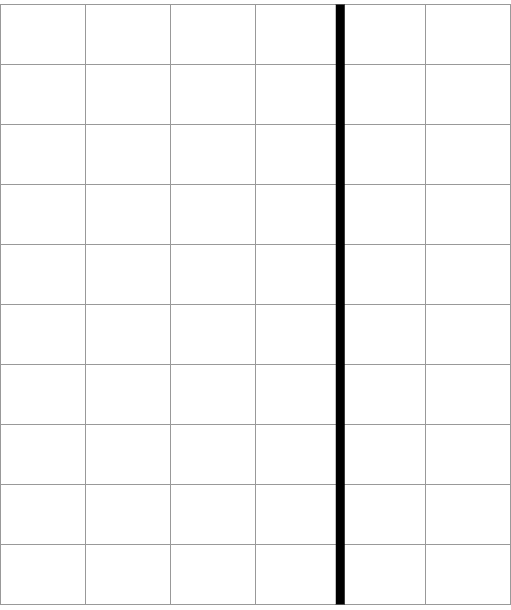
- The entire space is divided into a 6 x 10 grid.
- The parts that fold at 90 degrees are indicated with thick lines.
- The dimensions of each cell are not precisely determined, but it is sufficient for each cell to be roughly the size to accommodate an A5 sheet of paper. If we think of this grid as memory, then each address can hold a piece of information the size of A5.
- Each cell does not need to be the same size. In other words, this grid is more of a conceptual grid.
Address
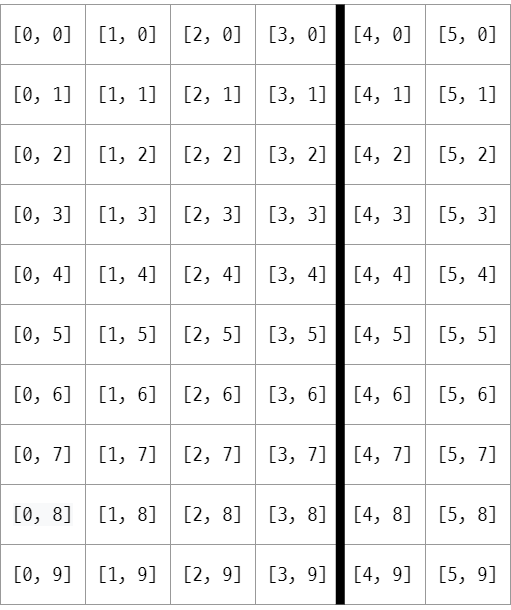
- Each cell can be assigned an address as coordinates shown above.
- The addresses are expressed as vectors for mapping onto a plane, but they can also be converted to scalars by multiplying the first number by 10 and adding the second number.
- Addresses were assigned during the initial ideation, but since they were not used in subsequent steps, they remain purely conceptual.
Reserved Space
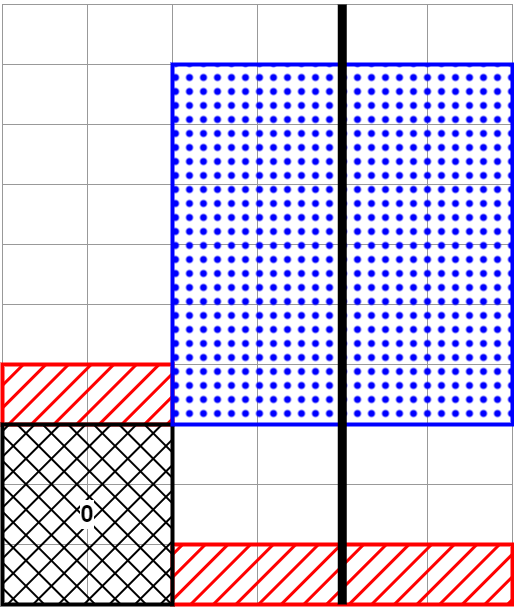
- The areas where windows will go are marked in blue.
- The space for the table to hold the tablet is designated as number 0. This position is expected to be where exhibition visitors will interact first. In addition to the tablet, a pamphlet explaining the exhibition will also be placed here.
- Buffer spaces were created above the table and at the floor area, marked in red.
Contents and Markers
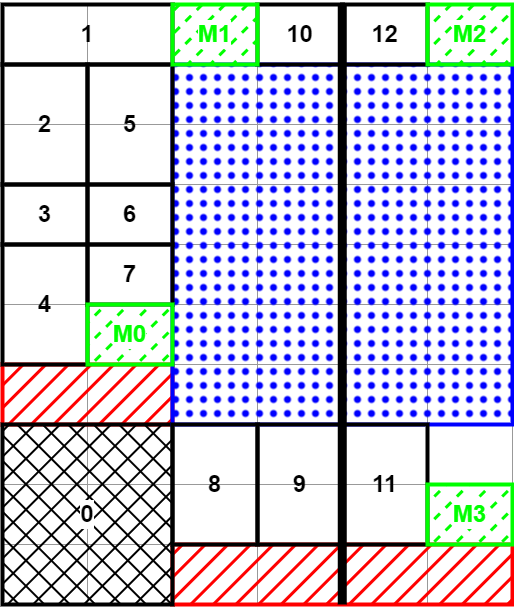
- Exhibition content was allocated to the remaining areas.
- Markers were allocated to the spaces left after assigning exhibition content. These markers will help the augmented reality application establish reference points when launched.