Antichamber Study
(ref: Virtual Space and Drawings - 1)
The opening section of Antichamber, a game released in 2013, features spaces that would be difficult to construct physically:
With some minor spoilers for the sake of explanation:
- Walking along a corridor, you reach a fork where stairs descend to the left and ascend to the right.
- Whichever path you take, you arrive back at the same fork you first encountered. This fork repeats infinitely regardless of which path you choose.
- If you give up going forward and turn back, a new path appears instead of the fork you previously passed through.
- Following this new path, you pass through six right turns before reaching a dead end.
Representing this experience in a drawing would look like the following. The hatched area represents the region the user can actually see from their current position — that is, the region whose existence they can confirm — while the area enclosed by black lines represents the region the user has previously passed through — that is, the region they knew to exist.
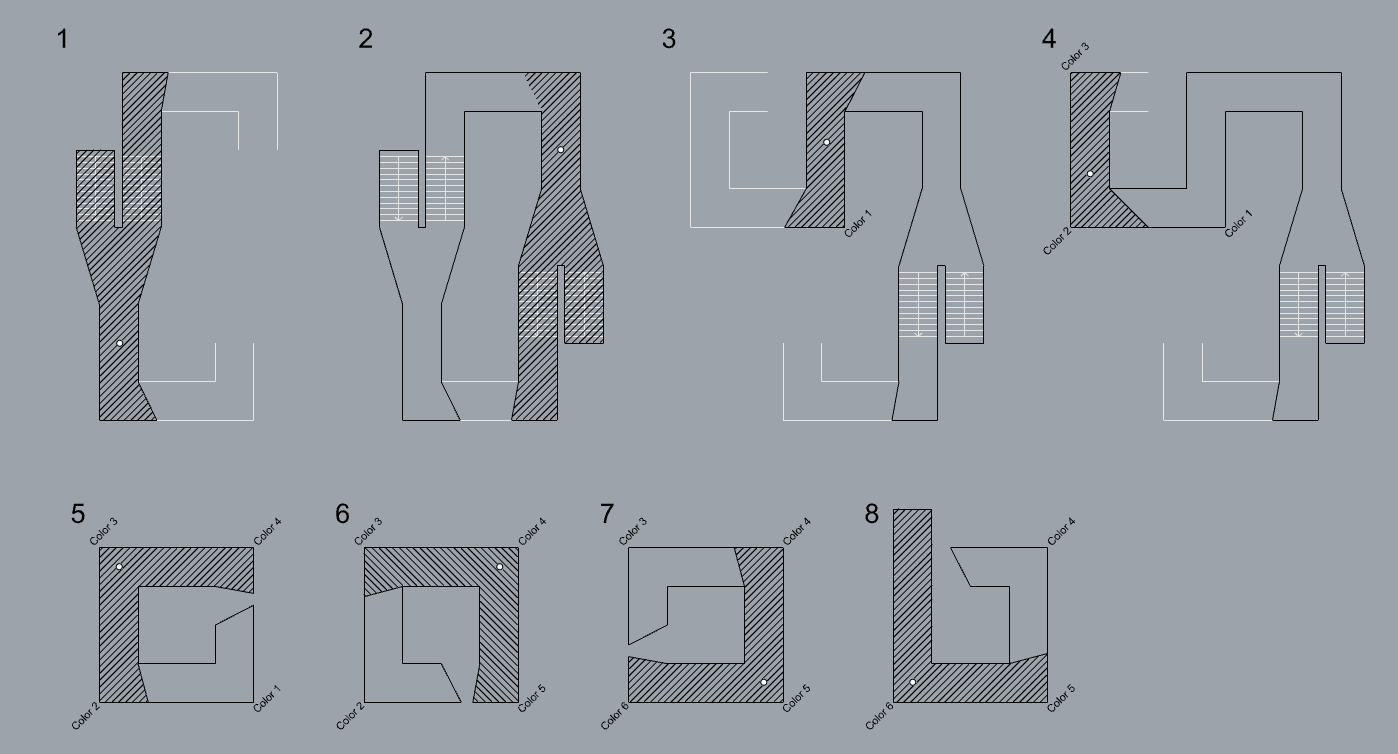
Even in just this section, two problems are already apparent:
- There is an infinitely repeating path. No matter how virtual the space may be, it exists in memory or storage, so infinite space would require hardware with infinite capacity.
- After making three turns in an "L" shape, the path should meet the previously traversed path, but it does not. This can be confirmed in the drawing by observing that when the user moves from position 4 to position 5, the corridor leading to the original fork has disappeared.
How can these problems be circumvented? If teleportation is possible without the user's knowledge while moving through the space, the problems could be solved as follows:
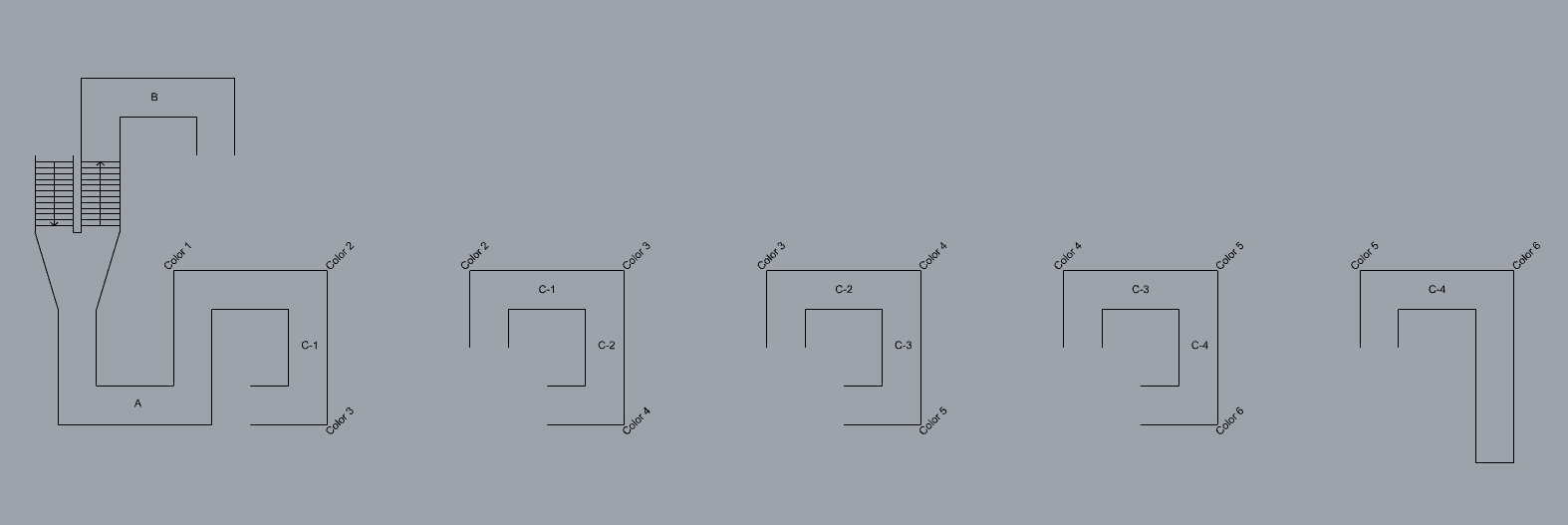
The letters in this image indicate teleportation locations, following these rules:
- When the user takes the right fork and moves from left to right through point B, they emerge at point A moving from right to left. The left fork can be explained similarly.
- When the user passes through point A from left to right, nothing happens.
- When the user moves from top to bottom through point C-1 in the left drawing, they emerge moving from left to right at point C-1 in the right drawing, and a similar thing happens when moving in the opposite direction. Similar behavior occurs at points C-2, C-3, and C-4.
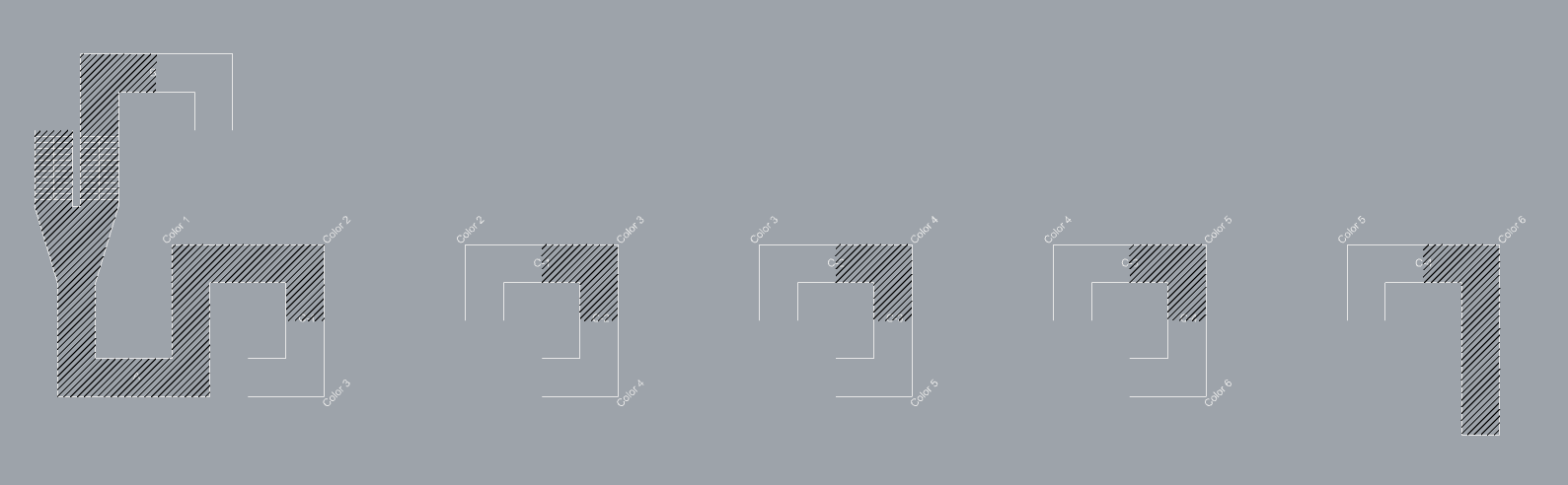
In this drawing, the area where the user can actually move is only the hatched region in the image below; the rest is merely visually observable.
Representing the initial drawing — the space as perceived from the user's perspective — on top of the teleportation-based drawing yields the following:
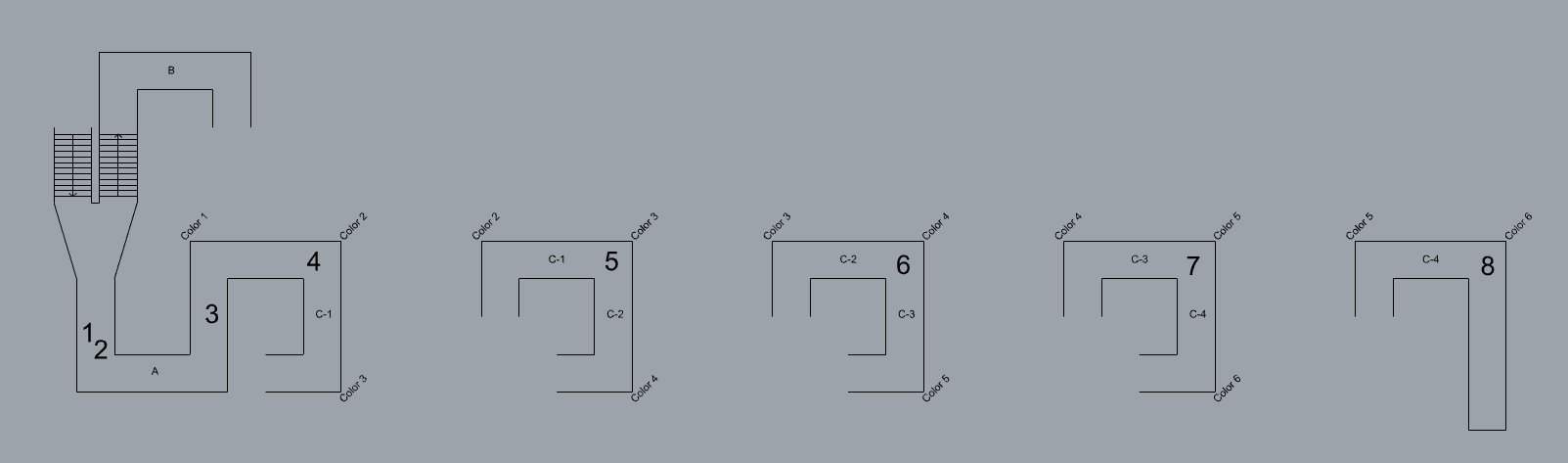
Simply by adding the rule that teleportation can occur without the user's knowledge, the problems of infinite space and physically contradictory spatial construction were resolved! However, this has caused a separation between the drawing of the space as experienced by the user and the drawing created by the space designer for spatial implementation. Why did this separation occur? Is it truly unavoidable?